Agentic AI explores how Large Language Models can be extended from generating individual responses into systems capable of carrying out complex, multi-step tasks. Taught by Andrew Ng, the course introduces the principles and design patterns behind agentic AI systems, where an LLM can reason about a task, decide what actions to take, interact with external tools, evaluate intermediate results, and iteratively improve its output.
The course builds on the capabilities of generative AI and Large Language Models by introducing workflows in which the model becomes part of a larger software system. Rather than relying on a single prompt and response, an agentic workflow can decompose a task into individual steps, execute these steps, observe the results, and determine what to do next. This iterative approach enables AI systems to address tasks that require multiple operations, external information, computation, or collaboration between specialized agents.
A central part of the course is the introduction of four fundamental agentic design patterns: Reflection, Tool Use, Planning, and Multi-Agent Workflows. Reflection enables an LLM to evaluate and improve its own output through iterative feedback. Tool Use extends the capabilities of the model by allowing it to interact with functions, APIs, databases, web search, code execution, and other external systems. Planning enables an agent to break complex objectives into executable steps and adapt the plan as new information becomes available. Multi-Agent Workflows extend this concept by coordinating several specialized agents that collaborate on different parts of a larger task.
The course also emphasizes that building effective agentic systems requires more than designing prompts and tools. Evaluation, systematic error analysis, and optimization are treated as integral parts of the development process. Agent behaviour can be evaluated both at the level of the complete workflow and at individual component level, making it possible to identify where failures occur and prioritize improvements. Practical considerations such as latency, computational cost, reliability, and the appropriate degree of autonomy are also addressed.
By implementing these concepts directly in Python rather than relying primarily on an agent framework, the course provides an understanding of the underlying mechanisms of agentic AI. This makes the design patterns applicable across different frameworks and platforms and provides a foundation for designing AI systems that combine LLM reasoning with software functions, external information sources, and autonomous workflows.
Topics and techniques
- Agentic workflows – multi-step and iterative LLM-based processes.
- Reflection – evaluating and iteratively improving generated results.
- Tool Use – connecting LLMs to functions, APIs, databases, code execution, and external resources.
- Model Context Protocol (MCP) – standardized integration of external tools and contextual resources.
- Evaluation and error analysis – measuring agent performance and identifying opportunities for improvement.
- Planning – decomposing complex objectives into executable and adaptive steps.
- Multi-Agent Workflows – coordinating specialized agents within a common workflow.
- Optimization – balancing autonomy, reliability, latency, and computational cost.
Practical exercises
The practical exercises use Python to build and examine agentic workflows from first principles. The labs progressively apply the course’s design patterns through examples including chart generation with reflection, improving SQL generation through iterative feedback, converting Python functions into LLM-accessible tools, and building an email assistant workflow.
Later exercises introduce component-level evaluation and more autonomous systems, including a customer service agent that combines planning with code execution and a multi-agent market research team in which specialized agents collaborate on a common task. Together, the exercises demonstrate how reflection, tools, planning, evaluation, and multi-agent collaboration can be combined into practical agentic AI applications.
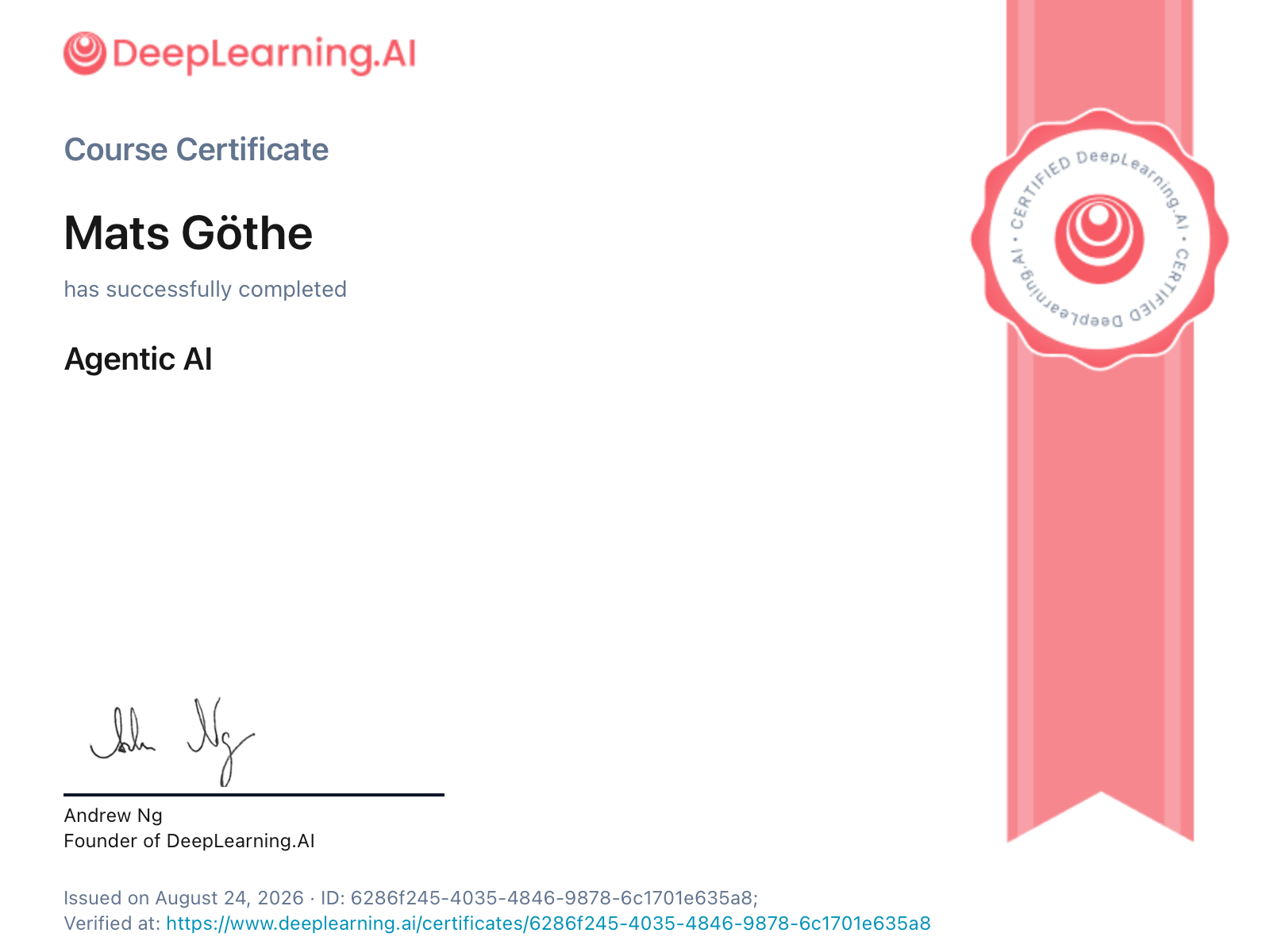
 DeepLearning.AI
Agentic AI.